Aline Cazante, MA
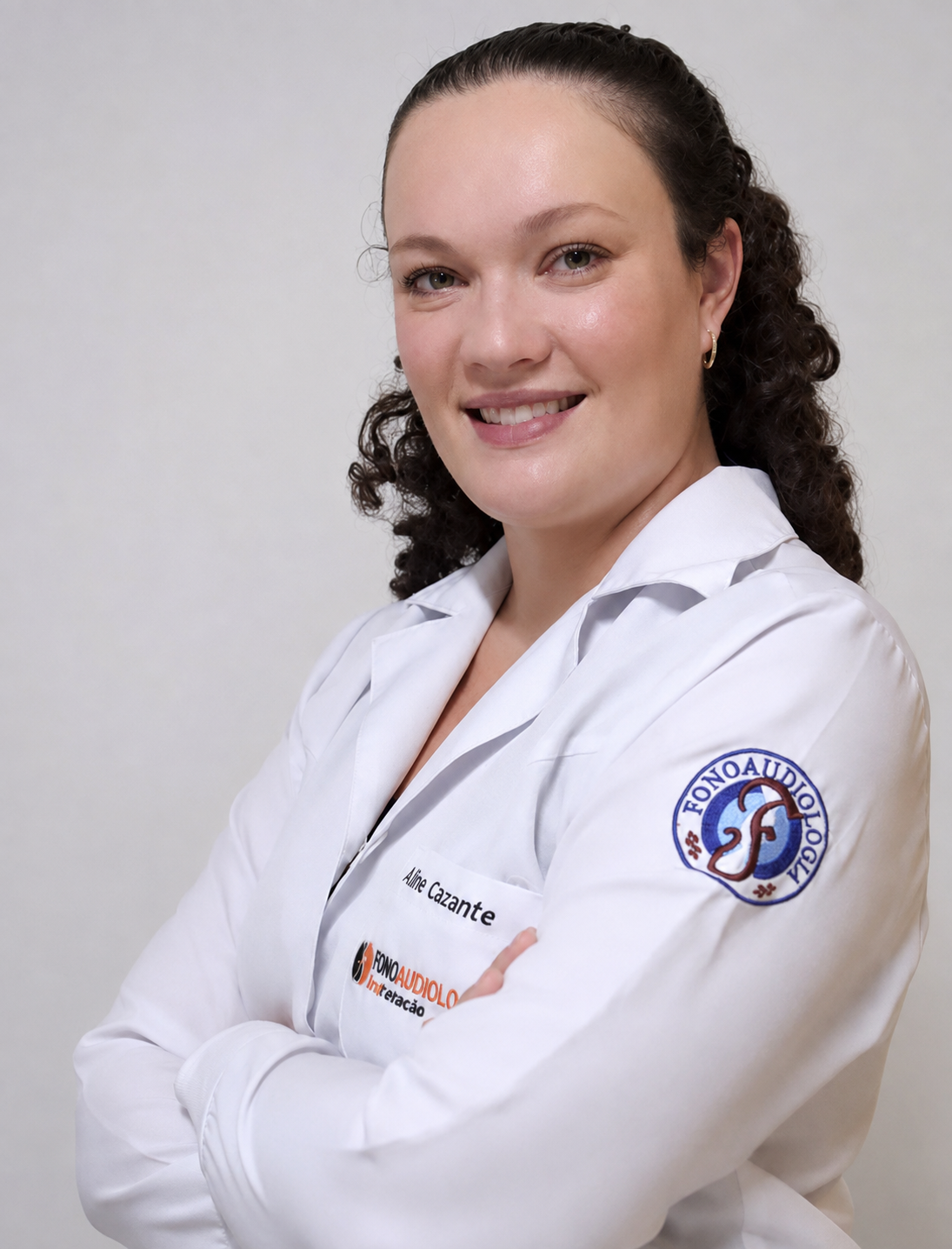
Aline Cazante, MA
Professional Profile
Aline Cazante is an educator, language specialist, speech-language pathologist, researcher, and scientific language editor whose interdisciplinary trajectory connects language studies, academic English, scientific communication, Speech-Language Pathology, educational practice, and digitally supported clinical assessment.
She holds a degree in Portuguese and English Language and Literature from the State University of Paraná (UNESPAR), postgraduate training in methodologies for teaching Portuguese Language and Literature in Basic Education, and a Master's degree in Letters from the State University of Maringá (UEM).
Her professional formation also includes a degree in Speech-Language Pathology from UniFatecie, postgraduate training in teaching English to children at the State University of Londrina (UEL), and TESOL/TEFL teacher certification from the World TESOL Academy.
She currently works as an English-language teacher in Elementary School II and High School, maintaining direct contact with language development, communication, reading, writing, and educational practice across different age groups.
This combination of academic English, language pedagogy, literary and linguistic studies, Speech-Language Pathology, and classroom experience provides a particularly relevant foundation for her role at JDHAB, where scientific language must remain clear, precise, technically faithful, and accessible to an international readership.
Letters, Language and Scientific Communication
Cazante's academic formation in Letters is rooted in the study of language, literature, discourse, textual interpretation, written expression, and the construction of meaning.
Her Master's research at the State University of Maringá examined language, silence, subjectivity, existence, and communication in the literary work of Clarice Lispector.
This humanities-based foundation is directly relevant to scientific editing. Scholarly language requires more than grammatical correctness: it depends on semantic precision, logical relationships, textual cohesion, appropriate terminology, argumentative clarity, and consistency between intended meaning and written expression.
Academic English, TESOL/TEFL and Language Education
English-language education represents a longstanding component of Cazante's professional trajectory. She currently teaches English in Elementary School II and High School and has complemented her academic training with TESOL/TEFL certification and postgraduate education focused on teaching English to children.
Her background supports an understanding of English not simply as a collection of grammatical rules, but as a communicative system in which meaning depends on syntax, terminology, context, textual organization, disciplinary conventions, and audience.
This perspective is particularly important in international scientific publishing, where authors frequently communicate complex scientific concepts in a language other than their first language.
Effective scientific language editing should improve clarity and readability without altering the evidentiary strength, uncertainty, limitations, or scientific interpretation intended by the authors.
Speech-Language Pathology and Human Communication
Cazante's degree in Speech-Language Pathology extends her academic expertise from written language into the functional and clinical dimensions of human communication.
Her continuing professional education encompasses areas related to speech and language development, phonological processing, literacy, learning difficulties, communication disorders, and Orofacial Myofunctional Therapy.
This background is particularly relevant when scientific manuscripts involve terminology related to speech, language, swallowing, orofacial function, behavioral assessment, rehabilitation, communication disorders, or patient-centered functional outcomes.
It also creates an important interface between linguistic precision and clinically meaningful communication, allowing terminology to be approached not only from a grammatical perspective but also in relation to the biological and functional concepts it represents.
Educational Practice and Inclusive Communication
Cazante's professional trajectory in education includes work involving language teaching, literacy, communication development, phonological awareness, and educational strategies designed to support learning.
Her interdisciplinary training allows educational questions to be examined through complementary perspectives from language studies and Speech-Language Pathology.
Particular attention is given to the relationship among spoken language, phonological processing, reading and writing acquisition, communication, and the educational participation of students with different learning and communication needs.
Digital Health and Clinical Outcome Assessment
Cazante's recent scientific work connects Speech-Language Pathology with Digital Health through the study of outcome measurement in Orofacial Myofunctional Therapy.
Her research examines how digital approaches may help move assessment beyond exclusively observer-dependent reporting toward outcomes that are more standardized, auditable, longitudinally comparable, and suitable for telepractice.
The work considers structured telepractice, web-enabled assessment, facial video analysis, acoustic markers, swallowing-related technologies, patient-reported monitoring, and governance issues associated with automated audiovisual information.
Importantly, the approach distinguishes technological measurement from clinical interpretation. Digital tools can strengthen documentation and reproducibility, but their outputs require appropriate clinical anchoring, validation, transparent analytical procedures, and reproducibility testing before they can be treated as meaningful clinical endpoints.
Scientific Copyediting and Language Quality
Scientific copyediting requires a balance between improving language and preserving the integrity of scientific meaning.
Cazante's background in Letters, academic English, TESOL/TEFL, language education, and Speech-Language Pathology provides an interdisciplinary foundation for reviewing scientific texts produced across clinical, biomedical, and technological fields.
Her editorial work includes attention to grammar, syntax, terminology, textual cohesion, readability, internal consistency, academic tone, and conventions of international scientific English.
Particular attention is also required when linguistic choices may inadvertently imply causality, validation, effectiveness, certainty, generalizability, or clinical significance beyond what the underlying study design and evidence support.
Editorial Role at JDHAB
As Copyediting and Language Editor at the Journal of Digital Health and Advanced Biomaterials, Aline Cazante contributes specialized expertise to the linguistic, semantic, and textual quality of the journal's scientific publications.
Her responsibilities include academic-English review, copyediting, terminology consistency, textual cohesion, readability, grammatical accuracy, and alignment with the journal's editorial language and style.
Her TESOL/TEFL training and practical experience teaching English are especially relevant to the internationalization of JDHAB, helping preserve clarity and disciplinary accuracy when manuscripts are prepared by multilingual authors.
Her training in Speech-Language Pathology provides additional subject-matter familiarity for manuscripts involving human communication, Orofacial Myofunctional Therapy, functional assessment, telepractice, swallowing-related outcomes, rehabilitation, and digital clinical measurement.
Within JDHAB's governance structure, language editing remains distinct from scientific editorial decision-making. Copyediting improves the communication of scientific information but does not modify study data, replace peer review, redefine methodological conclusions, or transfer scientific responsibility from the authors.
Research and Scholarly Focus
Selected Scientific Contribution
Contribution to the JDHAB Editorial and Scientific Scope
Cazante contributes to JDHAB at an intersection that is particularly important for an international multidisciplinary journal: the relationship between scientific evidence and the language through which that evidence is communicated.
Her background in Letters, academic English, TESOL/TEFL, classroom practice, and language education strengthens the journal's capacity to communicate scientific work through clear, coherent, and internationally accessible scholarly English.
Her training in Speech-Language Pathology adds a complementary health-science dimension, particularly for manuscripts involving communication, functional assessment, Orofacial Myofunctional Therapy, telepractice, rehabilitation, and digitally measured clinical outcomes.
Her contribution therefore extends beyond grammatical correction. It supports semantic precision, terminology consistency, clarity of scientific reasoning, appropriate expression of uncertainty, and language proportional to the strength of the evidence.